Monday, 27 August 2012

In Stanleys Padded Slippers

"Dr Livingston, I presume?" Words immortalised as much for their meaning as for their smugness. Dr David Livingston - arguably Africas greatest explorer wearing inarguably its greatest moustache - was sent into Africas heart one final time to solve a riddle apparently very important to the tea-swillers of nineteenth century England: where was the source of the Nile? He didnt find it. What he did find was malaria. And dysentery. So he holed up with a motley crew of Arab slavers in the town of Ujiji on the shores of Lake Tanganyika, taken for dead by most of the outside world. The editor of the New York Herald sniffed a great story and sent a new and cock-sure journalist to try find him in the off chance of landing an exclusive - possibly even one with a punchy catch-phrase. This journalist was Henry Morton Stanley. He wound his way across the wild interior of modern day Tanzania, found Livingston and no doubt botched the delivery of his most famous line. Or maybe even made it up later, as an after thought.

Our journey across Tanzania followed the reverse footsteps of Stanleys famous journey. With only a few small differences. While those haughty gentlemen favoured this method of transport:

We were forced into other less romantic kinds:
Sea ferry which has spent more time under the sea than Sebastian the Crab.
Train with all the breathing space of a Turkish sauna.
Ninety nine year old steamboat. It has sunk twice and seems on the cusp of a third.
Lake taxi where the only thing in shorter supply than life-jackets was horse-power.
Land taxis where the only thing in greater supply than the people riding inside were the people riding outside.

And our end-point, while it probably wont coin its own catch-phrase, was still no less enticing...

 Stanley, Shmanley.


Wednesday, 15 August 2012

The Shameless MV Liemba


The MV Liemba cannot be trusted. Kinglsey Holgate told me, and who am I to argue? A 99 year old ship with a history as chequered as hers needs to be watched very carefully. She has many faces. Not all of them pretty. Her true colours were belatedly shown to us - but by that stage it was too late.

She came from inauspicious beginnings. A humble upbringing in the blue-collar factories of Munich, she sailed in pieces to Dar es Salaam, took a third class carriage across to Lake Tanganyika where she found employment for her efficient and timeous German employers gayfully ferrying sauerkraut and brockhorst from port to port. With the advent of World War One she signed up for military service, her ride was pimped with some serious heavy artillery and she became the thorn in the side of the Allies dreams of arbitrarily controlling the lake at Africas heart. No one was more bleak than the Congolese, who were forcefully made to lug tons of dismantled ship through their sweaty jungles to reassemble into the vessels to rival the mighty Liemba. They did rival her, and she was scuppered to the bottom of the lake where she tried her hand at being an aquarium for eight rusty years. She then flipped allegiance - resurrected by the British after they were given German East Africa as their spoils of war - she shamelessly did their bidding. Two-faced. And smug.

Her flag was changed at Independence; she relocated entire villages as part of Nyereres disaterous socialist experiments; she embraced capitalism - ferrying tons of Tanganyikas dried and smelly gold (Kapenta fish), distributing it to the hoards of tiny vessels that swarm around her like bees too 99 year old honey. She even tried her hand at humanitarian work - skuttling around the refugees of the areas interminable conflicts.


The side we saw of her, however, was a very different one. It began with a rendezvous with Kingsley Holgate - an explorer as famous for blazing trails through Africas hinterland as for felling a litre of Captain Morgans in under 30 minutes. It was the last of these two attributes that the Liemba introduced us to. To the point where, arm on shoulder, I was begging him for the secret as just how his beard has so much body. Tough Guy, meanwhile, was brainstorming with him about starting a Royal Geographic Society of South Africa. He recommended himself as President. Kingsley could be his MD. My sister Claire forms the backdrop to all this - sprawled out bizarrely over three different backpacks. A empty bottle of rum clinking around at her feet.

So it was the next day that we saw the Liembas true colours. Keeling from side to nauseating side she is, first and foremost, an emetic. Shamelessly. I knew from the start she couldnt be trusted.


Monday, 6 August 2012

A Taste of Burundi


Rows of French baguettes. Perfectly soft custard puffs. Black-and-white-chequered floor. Credence Clearwater Revival. Creaky overhead fans. Wafts of fresh roasted coffee. Burundi. Sure.

The country does seem like the fat  kid never invited to the party. The ugly third sibling of Uganda and Rwanda - East Africas triplets of micro-states. Ridiculed. Ignored. This may be due to its ongoing ethnic tensions and low-level civil war. Or it may because a tourist visa is harder to come by than a whiff of Bob Mugabes underpants. Three days is all we were granted. Enough for just the tiniest taste. And most of it was spent doing just that: tasting. A patissorial explosion of baked treats - as far removed from the deep-fried sop of its neighbours as it's military is from allowing real democracy. The last country in East Africa with a lingering Franco-Belgian legacy, it sometimes feels like the abandoned movie set of a French silent movie. And then a mattress-laden cyclist, towed by a petrol tanker, careens suicidally past at 80km/hr just to remind you it isn't. A croissant on a Normandie-like beachfront. Followed by a military patrol hurtling by in vicious pursuit of nothing in particular.

With hints of French, whiffs of African and a pervasive texture of craziness, a taste of Burundi was a tiny but intense sensory experience. And like all great tasters, it only whet the appetite for more.


Monday, 30 July 2012

The Ghosts of Rwanda


Rwanda is like an onion. Or a parfait. It has layers. Arriving in Kigali is like arriving in an African parallel-universe. In this universe everything is ordered. Everything is clean. The scooter drivers wear helmets. The military wear smiles. There are no goats. But beneath this welcomed veneer of the perfect African capital lies something a little more sinister. Peel it back and everyone and everything has a vicious skeleton in the closer. The truth is: the ghosts of the genocide are really running the show.

The parish we stayed in, for example, hid two thousand Tutsis for months on end and saved their lives. The St. Famille Church next door was less fortunate and thousands were massacred there in a matter of hours. To escape these thoughts we went to the Hotel Mille Collines for a beer - only to find it was the hotel immortalised in the film 'Hotel Rwanda' for housing Tutsi refugees and expats escaping the bloodshed. Our own escape was difficult. Even at the taxi ranks, dismembered beggars mill about as an uncomfortable reminder that everyone in this country over the age of eighteen has either committed or witnessed the worst atrocities of the twentieth century.

The countryside is magnificent but is home to no less ghosts than the urban centres. The epic Virunga Volcanoes in the north: the area where the Tutsi rebels came in to Rwanda from to end the genocide. The azure waters of Lake Kivu: where a million fleeing Hutus formed the largest refugee camp in history. The perpetual blue haze that floats around Rwanda's thousand hills is like the aimless drifting of souls in limbo.

And yet, in spite of all this, the miraculous has occurred. Rwanda has pulled itself back from the abyss and has thrived since 1994. From being the WHO's Worlds Poorest Country where not even a single type-writer remained in the civil service it is now the site of huge development projects and a booming economy. A people that tore themselves to shreds have somehow reconciled and moved forward together. The ghosts still linger in every household and in on every street corner. But eventually they too will find some rest.


Monday, 23 July 2012

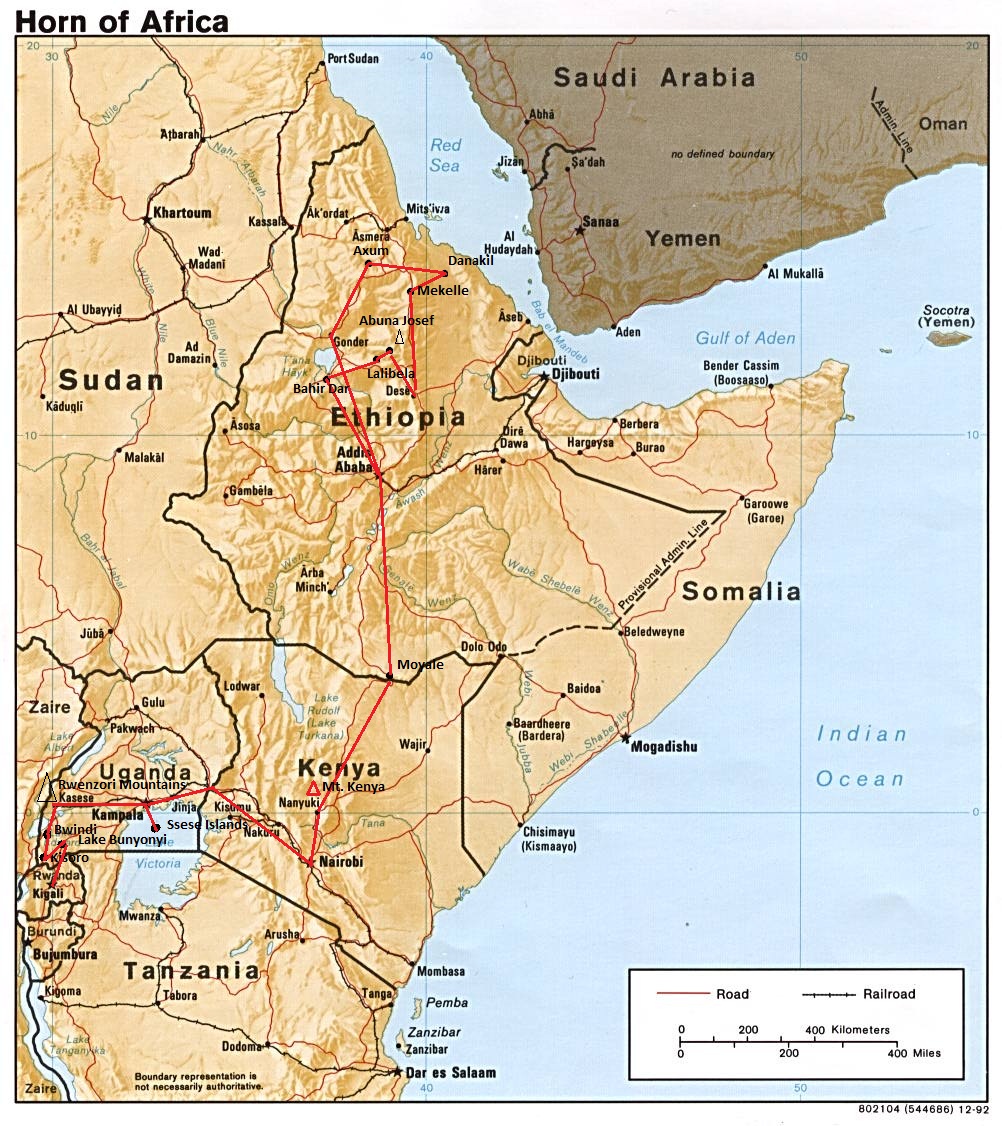
East Africa Round-up


Our first leg through East Africa is done. Its been extreme in every sense. We've experienced the 52 degree blow-dryer heat of the Danakil Depression to the minus 8 blizzard on the peak of Mount Stanley and pretty much everything in between. We have dodged bilharzia and over-confident donkeys on Africas biggest lake in Lake Victoria. We have climbed shear cliffs to visit churches emerging from solid rock. And then been pelted with rocks emerging from childrens hands. We've had our bowels rocked by Ethiopias bizarre concoctions and had them soothed by Ugandas chapti and beans.  Ive had my bus fare paid for by an elderly local in dungarees. And Ive torn my beard out in frustration more times than i can count.

It hasnt always been roses and potpourri. But its certainly never been boring. And hardly ever thermo-neutral.


Here are some of the stats:

Mileage to date: 16444km

Funds raised for the Key School: R40,000

Peaks: 4 - Abuna Josepf (4300m), Mt Kenya (4950m), Mt Stanley (5109m), Mt Gahinga (3600m)

Troughs: 2 - Danakil Depression (-116m), David Cloetes naked arse (sags -1,5m)

Times vomited on while in transit: 2

Times been crapped on by poultry while in transit: 1

Chapatis eaten: >400

Prostitutes encountered in Kenya: 52

Prostitutes hitting on Tough Guys father:  52

Prostitutes hitting on Tough Guy: 0


Tuesday, 17 July 2012

Endangered


The mountain gorillas have known it for a while. Eastern DRC is kak. As their numbers dwindled to a few hundred - slaughtered for meat, ashtrays and funsies - they have taken refuge in the slightly safer regions of Rwanda and Uganda. Here, the volcanoes are inactive and the locals have less blood lust. Likewise the gorillas, far from being seen as furry table ornaments on legs, have assumed celebrity status - bringing in more money to these military coffers than a decades supply of sorghum. Here, their greatest threat is being poked in the eye by an Americans telephoto lens.

We share a lot with these benevolent, furry giants. Our genes, for example. 98,5% of them according to new genetic research. Then there are our behavioural traits. Just five minutes watching their juveniles cavort, adolescents swagger and adults exasperate will give Creationists plenty to think about. Then there is our plight. Both people and gorillas in this region have had it rough. If the columns of Congolese refugees pouring down the road towards us into the Kisoro Refugee Camp wasn't enough to convince us of this, then the thunderous mortar fire just a few kilometers over the border certainly did. And just like our genetically similar cousins, we grunted, hosed down our immediate surroundings with diarrhoea and bolted.

In a region as tumultuous as the Virunga Volcanoes its no small miracle that these creatures still exist at all. Especially after more than two decades of ongoing violence and upheaval and when rebel factions are led by people nicknamed 'The Terminator'. And its pretty sobering to realise that we are, infact, just like our counterparts who face a horrifically uncertain future in this region. The main difference being that very few tourists will spend 500 dollars for an hour observing refugees mill around their smelly camp.

I suppose its in out nature to focus on happy, life-affirming things rather than death, destruction and rebel leaders with terrifying names. In this too, the gorillas are just like us - they frolic blissfully in the afternoon sun, scratching their bellies and beating their chests, completely unaware of the shit storm around them. It is probably for the best. They, like us, are born survivors.


Monday, 9 July 2012

The Mysterious Mountains of the Moon


The Mountains of the Moon. Just the name conjures images of mystery, mystique, the bizarre. Throw in the fact that they are Africa's largest mountain range, nestled in its tumultuous heart straddling both the equator and the border of Uganda and the DRC and its enough to get even JM Coetzee to take up tap-dancing and travel writing. They eluded the cross-continental European explorers for decades - hiding behind their perpetual shroud of misty goodness. It took the might of Henry Morton Stanley to finally bludgeon his way into the range, part the mists and note their snow-capped equatorial peaks and - at a loss for humour and originality - named the largest of them 'Mount Stanley'. How he came to be one of the regions great explorers is just one of the great mysteries of the mountains.

To unravel these and other mysteries, our expedition needed fortification. Reinforcements were called for and arrived in the form of Tough Guys indomitable family. Our clan - now five strong - began in high spirits. The verdant humidity of equatorial jungle gave way to bamboo forests, pygmy-swallowing marshes, cavernous valleys of enormous Senecio and Lobelia, interstellar lunar rock formations, mountain-top glaciers. These varying landscapes became more extreme with every day. As did the nausea pervasive in our party. Altitude sickness and corned beef are not the best of friends, it turns out. As the air thinned, so did our numbers - and so answering one more mystery: that altitude-prevention tablets are about as effective as beetroot, olive oil and a positive attitude.

For the summit we were only three. The Proclaimers 'I Would Walk 5000 Miles' a worthy substitute for 'Eye of the Tiger' as a motivator to gear us up for the culmination of our trek. The full moon cast cryptic shadows on the glaciers, the sun was rising over the clouds thousands of metres below us. One of our party began to believe that she was being swallowed by giant mouths rising out of the snow. I drew on ten years of hard medical experience and diagnosed that she was buggered. The mountain had claimed another.We were down to two. As our incompetent guides fumbled from one obstacle to the next, we somehow found ourselves on the summit of Margherita peak. It was now blizzarding - the only view on offer that of our guide tripping over his own harness. But we had made it, so offered the mountain a sip of whiskey and a Super-C as an offering of thanks for sparing us her various perils. Perhaps it was time for us to make a speedy descent.

The three-day descent down to base camp was achieved unceremoniously by sliding the better part of four-thousand vertical metres on my arse. And all the way, as chafe and haemorrhoids set in, I pondered the questions that still remained. Such as: why a landscape as spectacular as this one remains so obscure? How are those guides still alive? And, perhaps most pressingly, why everyone in the Rwenzoris is named either 'Willy' or 'Johnson'?

I reckon its better some things about those mountains remain a mystery.